New device sign in confirmation

Hi!
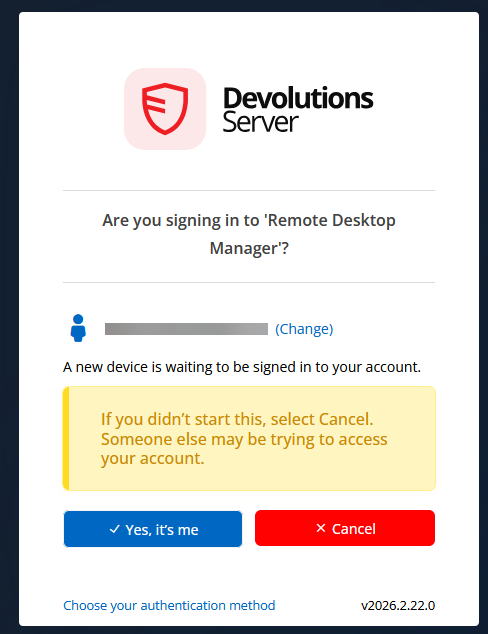
Since one of the latest DVLS 2026.2 patches we get this login confirmation message each time a user signs in from RDM or DPM (browser extension).
Is the confirmation showing up every time by design? It says "a new device is waiting to be signed in to your account". Shouldn't the message appear only the first time? We have set the token to expire every day.
It's just an extra click, so no big deal, but I was wondering. Also I'd have expected such a change with a major update, not with a patch. I couldn't find anything about this in the release notes either.
Thank you!
Daniel
All Comments (3)
Hi Daniel,
Thanks for raising this.
The confirmation was added in DVLS 2026.2.19 to fix a security issue in the device sign-in flow used by RDM and DPM: https://devolutions.net/security/advisories/DEVO-2026-0035/. An attacker could send a user a crafted sign-in link, and if that user already had an active session or SSO, their device was approved silently. Because it was a security fix, we shipped it in a patch.
The prompt appears only when a new interactive sign-in is needed, not every time RDM or DPM starts. Your token expires after 24 hours, so users sign in again every day and see the confirmation every day.
Could you tell us why the token is set to 24 hours? Is it a security policy, a compliance requirement, or something else? If there’s no strict need for it, a longer lifetime would mean users see the prompt less often.
Thanks!
Benoît Sansregret
Hi Benoit!
I see, thank you! We set token to expire after 12 hours for security, combined with a policy that requires phishing-resistant MFA each time.
Thanks for clarifying that it's by design! But, without knowing the details, I feel like there should be a better solution to avoid replay attacks, rather than simply asking the user, who will probably still click Yes anyway.
Thank you!
Daniel
Hi Daniel,
Thanks for the details. A 12-hour token with phishing-resistant MFA each time makes sense.
I agree the confirmation isn’t the ideal long-term solution. We added it to close the security issue quickly, and we’re still working on a better solution that protects this sign-in flow without adding an extra step for the user.
I’ll update this thread when the new solution is available.
Thanks!
Benoit
Benoît Sansregret